



Why study Automotive Technology?
Mobility is undergoing a profound transformation. Vehicles are becoming cleaner, smarter, more connected, and increasingly autonomous. In the two-year MSc in Automotive Technology at TU/e, you learn how to design and develop the next generation of mobility solutions by combining mechanical engineering, electronics, software, data, and human-centred design.
At TU/e, you approach vehicles as integrated systems and learn to solve complex multidisciplinary challenges. From autonomous driving and advanced driver assistance systems to electric powertrains and connected mobility solutions, you develop the expertise needed to shape the future of transportation. Studying in Brainport Eindhoven also gives you direct access to one of Europe's leading high-tech innovation ecosystems.
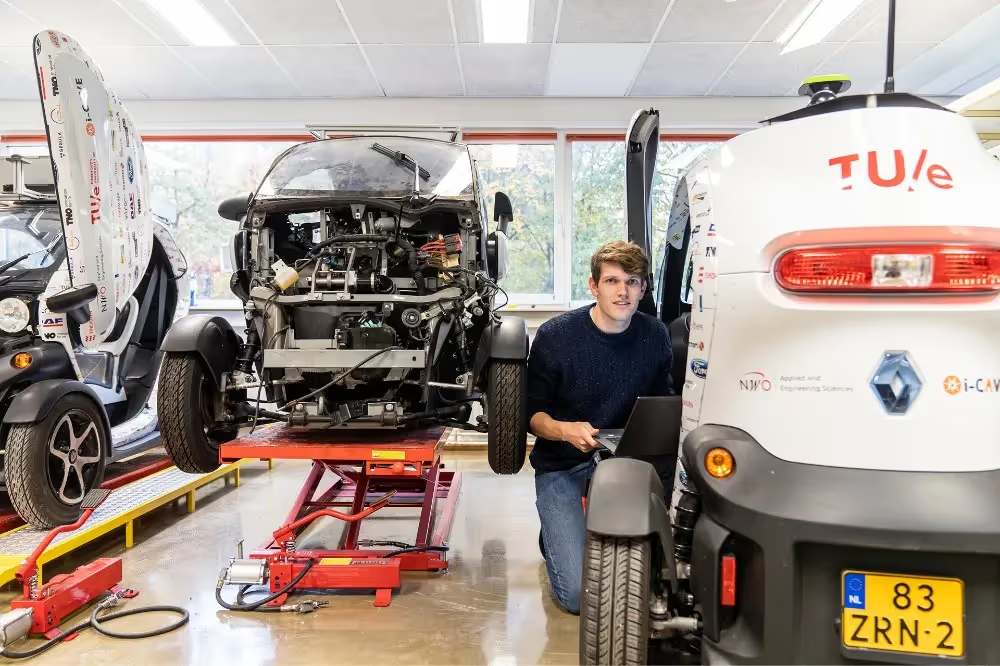
Three unique strengths
- Design the future of smart and sustainable mobility
Develop the expertise to create the next generation of vehicles and transportation systems, from autonomous driving technologies and connected vehicles to electric powertrains and sustainable mobility solutions. - Learn through a unique multidisciplinary approach
Combine knowledge from mechanical engineering, electronics, software, control systems, and human-machine interaction. By understanding how these disciplines work together, you'll learn to solve the complex challenges facing modern mobility. - Innovate in Europe's leading high-tech and automotive ecosystem
Study in Brainport Eindhoven, where automotive companies, high-tech innovators, and research institutes collaborate on the mobility solutions of tomorrow. Through industry-connected projects and research, you'll apply your knowledge to real-world challenges and build a strong foundation for your future career.
Connection with semiconductors
Modern mobility would not exist without semiconductors. Advanced sensors, vehicle control units, power electronics, connectivity systems, battery management technologies, and autonomous driving functions all depend on increasingly sophisticated semiconductor technology.
In Automotive Technology, you learn how semiconductor-enabled technologies interact within complex vehicle systems. Whether you are working on intelligent sensing, electric propulsion, automated driving, or connected mobility, you gain the systems-level understanding needed to develop the next generation of high-tech transportation solutions.
Programme structure
The programme combines a strong systems engineering foundation with the flexibility to focus in your area of interest. During your studies, you develop expertise in topics such as vehicle dynamics, control systems, embedded software, electronics, electric powertrains, autonomous driving technologies, and human-machine interaction.
You can tailor your studies through two key themes:
- Smart Mobility: Focus on autonomous and cooperative driving, connected vehicles, embedded software, sensing technologies, control systems, and human factors.
- Sustainable Mobility: Explore future propulsion technologies, electric and hybrid vehicles, energy-efficient powertrains, and innovations that contribute to more sustainable transportation.
The programme culminates in a major research project carried out in close collaboration with researchers and industry partners.
Career perspectives
Graduates of Automotive Technology are equipped to tackle complex mobility challenges in both the automotive and high-tech sectors. Career opportunities include roles such as Systems Engineer, Automotive R&D Engineer, Control Engineer, Software Engineer, Vehicle Dynamics Engineer, and Mobility Innovation Specialist.
Many graduates contribute to innovations in autonomous driving, electric mobility, intelligent transportation systems, semiconductor-enabled vehicle technologies, and advanced high-tech systems. Others continue toward research careers that help shape the future of sustainable and connected mobility.


